SocleAIvsHermes
Hermes, built by Nous Research, is a self-hosted personal agent that accumulates memory and creates its own skills over time. Socle AI is the platform an organisation uses to build, orchestrate and govern its agents.
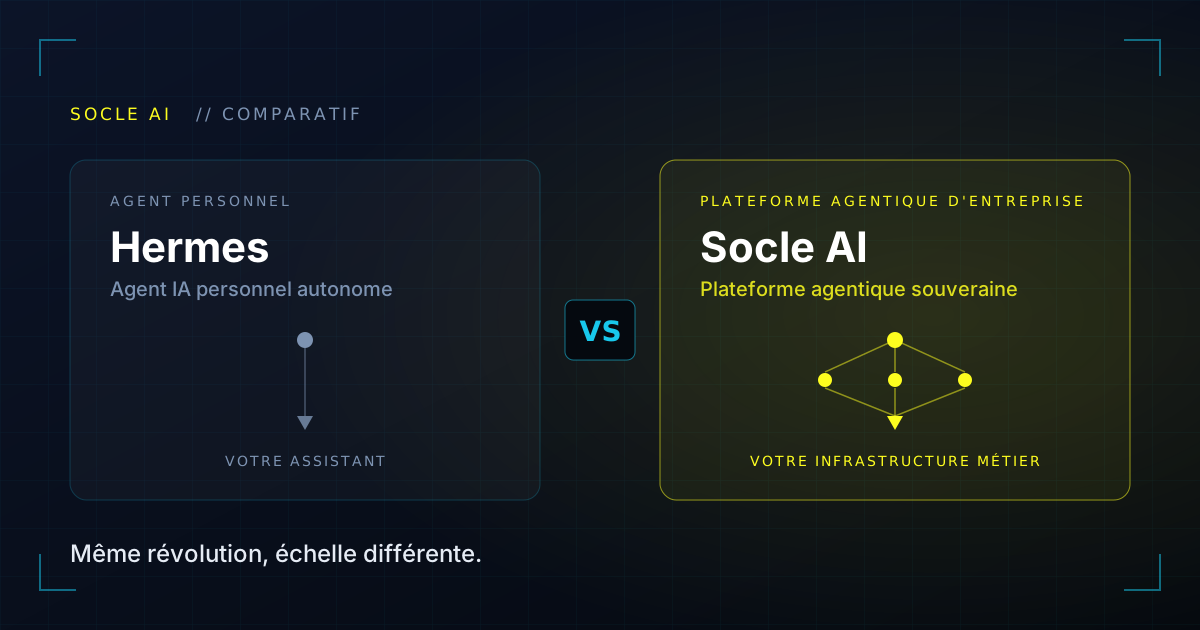
THE OTHER APPROACH
Hermes
Autonomous personal AI agent
OUR APPROACH
Socle AI
Sovereign enterprise agentic platform
Same revolution, different scale. Hermes is built around the agent, Socle AI around the organisation: specialised agents, ecosystems, workflows, roles, isolation and traceability.
GOOD TO KNOW
These two tools do not exclude each other. Hermes can call any OpenAI-compatible endpoint: a Socle AI agent or ecosystem plugs in like a model, giving the personal agent access to the organisation's document RAG and governed business tools.
An agent that grows with you, a platform that grows with your organisation
HERMES
PERSONAL AGENT
Your agentSOCLE AI
ENTERPRISE AGENTIC PLATFORM
Your agentsHermes is built around the agent. Socle AI is built around the organisation.
The line-by-line comparison
| CRITERION | HERMES | SOCLE AI |
|---|---|---|
| Audience | Individuals, developers, power users | Companies, product and tech teams |
| Core unit | One persistent agent | Specialised agents |
| Long-term memory | Key strength, self-curated memory | Memory per agent and per organisation |
| Skills | Self-learned, agentskills.io standard | Configured agents, tools and workflows |
| Multi-agent | Specialist bots and subagents | Native orchestration (A2A) |
| Visual workflows | Not documented | Drag-and-drop builder |
| Models | Multi-provider, any endpoint | Multi-model, OpenAI-compatible API |
| Multimodality | Agent and tool oriented | Text, vision, ASR, TTS, image |
| Organisations and roles | Not documented | Roles, isolation, dedicated API keys |
| Traceability | Logs and history | Step-by-step execution audit |
| Deployment | Self-hosted (local, Docker, SSH…) | SaaS in France or on-premise |
What Hermes covers, and where it stops
An agent, not an organisation
Hermes is designed around a persistent agent that knows you. Bot mode and subagents let several specialists work together, but the unit of account stays the user, not the company.
No multi-organisation governance
The documentation describes neither admin/member/guest roles, nor strict isolation between organisations, nor usage tracking per team: all prerequisites once IT has to open the tool to several business units.
No visual workflow builder
The chain of actions is decided by the agent, which is powerful for personal use. A business team that has to replay a process identically, with conditions, branches and human validation, will look for an explicit workflow.
Hosting and operations are on you
Self-hosting is a real control advantage, but installation, updates, backups and availability remain the responsibility of whoever deploys it. There is no operated sovereign SaaS offering.
What Socle AI brings to an organisation
Build: specialised agents rather than a single agent
Each agent has its own model, instructions, memory, knowledge base and tools. A legal agent, a support agent and an analysis agent share neither the same context nor the same access rights.
Orchestrate: agent ecosystems
An ecosystem selects the agents a request needs, runs the steps and synthesises the result through the A2A protocol. The orchestration is declared, not left to the initiative of a single agent.
Automate: a visual workflow builder
Agents, conditions, API calls, tools, notifications, branches and sub-workflows by drag and drop, triggered manually, by webhook or on a schedule, with human validation wherever it is needed.
Scale: governance and sovereignty
Multi-organisation, roles and isolation, usage tracking, dedicated API keys, audit log and data purge. As SaaS hosted in France on Scaleway, or on-premise on your own servers.
Integrate: OpenAI compatibility and business tools
The OpenAI-compatible API lets you call an agent or an ecosystem like a model, from your existing applications, your MCP servers and your business connectors.
Key questions you should be asking!
A personal agent learns from its user. What happens when that person leaves the company, and who owns the memory it accumulated?
How will you open this usage to several teams with roles, data isolation and usage tracking per organisation?
Can your critical processes rely on a chain of actions decided by the agent, or do you need an explicit workflow that can be replayed and audited step by step?
The questions we get most often
OBJECTION
« Hermes is open source and self-hosted, that is already sovereign. »
OUR ANSWER
Self-hosting does give you control over execution, and that is a genuine strength. Enterprise sovereignty additionally requires operated hosting, isolation between organisations, traceability of decisions and a contractual guarantee on where data lives. Socle AI offers SaaS in France on Scaleway or on-premise, with the governance layer that goes with it.
OBJECTION
« Hermes's persistent memory and self-learned skills are more advanced than configuring agents. »
OUR ANSWER
That is true, and it is the heart of its proposition: an agent that improves on its own by observing you. In a company, that same autonomy becomes a compliance question: you have to be able to say who has access to what, replay a decision and justify it. Socle AI therefore favours explicitly configured agents and traced workflows.
OBJECTION
« Our developers prefer an agent they fully control locally. »
OUR ANSWER
The two coexist very well. Socle AI exposes an OpenAI-compatible API: Hermes can point at a Socle agent or ecosystem like any other endpoint, and pick up the organisation's document RAG and business tools, without your developers giving up their personal agent.
Want to compare on your own use case?
Try the platform, or talk it through with someone who has already deployed this kind of project.